Why Your Sports Bra Band Rides Up When You Have a Long Torso
Quick Answer: A sports bra band rides up when the distance from your shoulder to your underbust is longer than the pattern assumes, so the straps reach their limit and pull the band upward off your ribs. Sizing down in the band makes it tighter without making it longer, which is why that fix usually fails. What works: bras with adjustable straps, longline bands that distribute the pull over more surface area, racerback styles with a lower back attachment point, and checking strap-to-band length rather than cup size.
You put the bra on, it sits correctly, and forty minutes into a run the band is somewhere near your bottom rib on one side and higher on the other.
The instinct is that it is too big. Usually it is the wrong length, and those are different problems with different solutions.

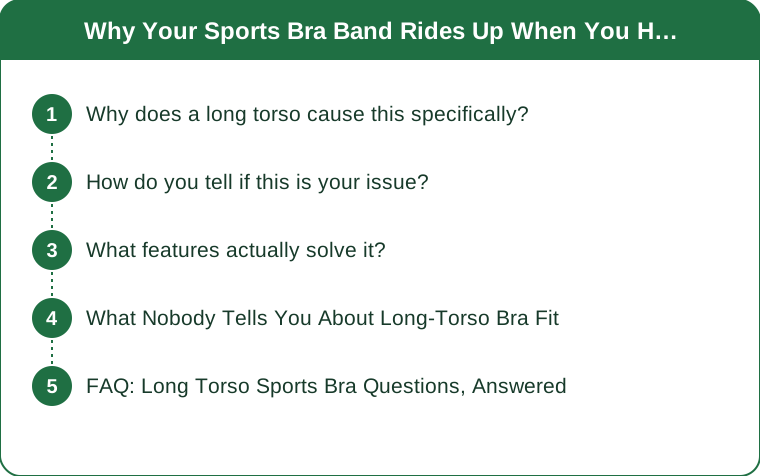
Why does a long torso cause this specifically?
Because a bra’s vertical measurements are drafted from a standard, and your standard is longer.
A sports bra has to span from the shoulder, over the bust, to the underband. On a longer torso, that path is longer, often by 3 to 6cm compared with the pattern’s assumption.
What happens when the path is too short:
- The straps reach full extension and cannot lengthen further
- The band becomes the only part with any give, so it gets pulled upward
- The bra ends up sitting higher than the underbust, where the ribcage is narrower and more mobile
- On the narrower part of the ribcage, the band has less to grip, so it keeps migrating
Why sizing down makes it worse. A smaller band size is tighter around, and it is not longer vertically. You have increased the tension pulling the band upward while reducing its circumference, so it grips harder in the wrong place.
The diagnostic: if the band is uncomfortable and still moving, the problem is length. If the band is loose and moving, it is circumference. These feel similar and they are not.
How do you tell if this is your issue?
Two quick measurements and one observation.
Measurement 1, your underbust to shoulder distance. Measure from the top of your shoulder, where a strap would sit, down over the fullest part of the bust to the underbust line. Compare against a bra you own that fits, laid flat and measured the same path.
Measurement 2, your torso length. From the bony prominence at the base of your neck to your natural waist. Roughly 40 to 43cm is average for adult women. Above 45cm generally means long-torso patterns will fit better than standard.
The observation: put the bra on and reach both arms overhead. If the band lifts off your ribs and stays lifted, the vertical span is too short. If it lifts and settles back down, the band circumference is fine and you are just seeing normal movement.
A useful second check: look at the strap adjusters. If they are at or near their maximum length in a bra that still rides up, that is confirmation. There is nothing left to lengthen, so the band absorbs the difference.
One thing this is not: a cup volume problem. Long torsos are frequently sold larger cup sizes to compensate for the vertical shortfall, which produces a bra with too much room in the cup and the same riding-up problem.

What features actually solve it?
Look for these, in order of how much difference they make.
1. Adjustable straps, genuinely long. Non-adjustable pull-on sports bras are the worst option for a long torso, because they have a fixed vertical span with no accommodation at all. Adjustable straps with a long range of travel are the single most important feature.
2. Longline bands. A band that is 8 to 15cm deep rather than 3cm distributes the upward pull across much more of your ribcage, and the extra surface area resists migration. Longline styles are the most reliable category for long torsos, and the additional benefit is that they cover the gap between bra and waistband.
3. Racerback with a low attachment point. Where the straps converge at the back matters. A high convergence, up near the shoulder blades, shortens the effective vertical span. A low convergence, further down the back, lengthens it.
4. Bands with a hook-and-eye closure. Any bra you can adjust around independently of the vertical span gives you two dimensions of fit instead of one.
5. Encapsulation rather than pure compression. Compression bras rely on downward pressure over the whole bust, which requires the vertical span to be right. Encapsulation styles hold each side separately and tolerate variation better.
What to avoid: short-band pull-on crops with fixed straps, high-neck styles with a high back convergence, and anything described as one-size or seamless with no adjustment.
What Nobody Tells You About Long-Torso Bra Fit
Brand sizing varies more vertically than horizontally. Two brands at the same nominal size can differ by several centimetres in strap-to-band length while matching closely in band circumference. This is why one brand works and another never does at the same size, and it has nothing to do with quality.
Bras designed for tall ranges are drafted differently, not just longer overall. Some brands’ tall lines lengthen the torso span specifically, which is what you want. Others simply scale everything up, which changes cup volume too. Read what the tall range actually adjusts.
A band that rides up chafes in a specific place. Right at the inframammary fold or just above it, where the band is now sitting on the moving part of your ribs. If your chafing is above the band rather than under it, that is diagnostic.
Two bras layered is a real strategy and not a great one. People with long torsos often double up a crop over a bra to stop movement, which works and adds heat and compression. A longline in the right span does the job better.
Straps at maximum length are a hidden hazard. Fully extended straps have no adjustment left as the elastic relaxes over months, so a bra that fit at purchase becomes a riding-up bra within a season. Buy with some adjustment left in reserve.
The high-impact complication: for running, breast movement is largely vertical, and controlling it requires the band to stay put. A band that migrates upward during a run is why some people conclude no sports bra works for them for running. It is a span problem, and a longline with adjustable straps usually resolves it.
Seasonal note: as training moves indoors and layering increases, a riding-up band gets harder to notice and more uncomfortable, since a fitted top over it holds it in the wrong position. This is a good moment to check the fit on your main training bras rather than in spring when they are visible.
FAQ: Long Torso Sports Bra Questions, Answered
Why does my sports bra band ride up?
Usually because the shoulder-to-underbust span of the bra is shorter than yours, so the straps reach their limit and pull the band upward onto the narrower, more mobile part of your ribcage.
Should I size down if my sports bra rides up?
No, in most cases. Sizing down makes the band tighter without making it longer, which increases the upward pull. Look for adjustable straps and a longline band instead.
What sports bra style is best for a long torso?
A longline band with fully adjustable straps and a low back convergence point. Avoid fixed-strap pull-on crops, which offer no vertical adjustment at all.
TL;DR:
- Riding up is usually a vertical span problem, not a circumference problem. The straps run out of length and the band gets pulled up.
- Sizing down makes it worse, because it adds tension without adding length.
- Look for adjustable straps with travel left in reserve, longline bands, and a low back convergence point.
- Chafing above the band rather than under it is a reliable diagnostic sign.
Measure your shoulder-to-underbust path once and compare it against the bras you own. It explains more than any size chart will.
See It in Motion
Seen here: Racerback Tank Top - White — shop similar styles on bubblelime.com
Keep Reading
This article is for general informational and styling purposes only. Fit, sizing, and product availability may vary.
