Why Belts Never Sit Right on a Long Torso (And What Actually Fixes It)
Quick Answer: On a long torso, your natural waist sits lower relative to standard pattern proportions, so belts and waistbands designed for average torso length often land at your hip instead of your waist. Look for high-rise cuts and adjustable, longer belts.
You’ve bought three belts that all do the same annoying thing: ride down to your hips within an hour. That’s not a belt problem — it’s a proportion problem most brands don’t design for.

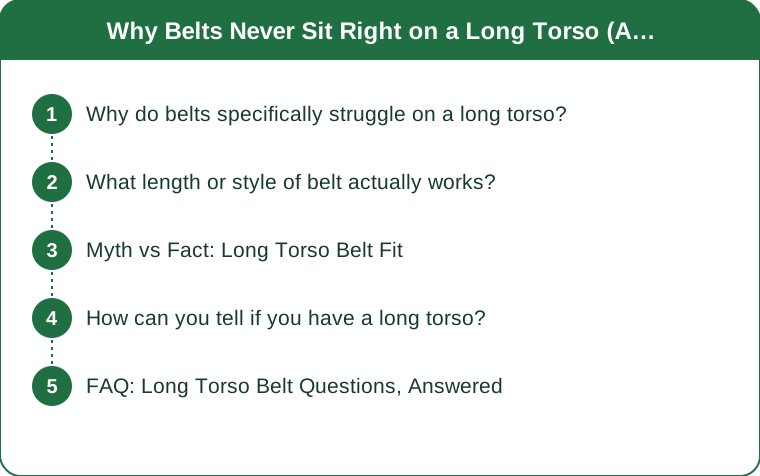
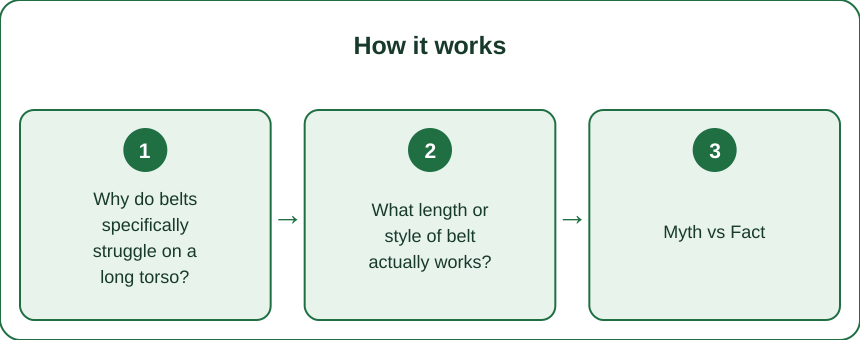
Why do belts specifically struggle on a long torso?
Most bottoms and belts are patterned for an ‘average’ torso-to-leg ratio. If your torso runs long, your natural waist sits lower on your body than the pattern assumes, so a belt cut to a standard rise ends up sitting at your natural waist by design — but that’s lower than where a belt ‘should’ visually sit for balance, making outfits look unbalanced.
What length or style of belt actually works?
Choose a belt with at least 2 extra inches of adjustability beyond your measured waist, and favor high-rise bottoms that already sit closer to true waist. A slightly wider belt (1.5-2 inches) also anchors better than thin belts, which tend to twist and slide on a longer midsection.

Myth vs Fact: Long Torso Belt Fit
Myth: Any belt works if you pull it tight enough. Fact: Over-tightening a too-short or too-narrow belt just creates bunching and discomfort — it doesn’t fix the rise mismatch causing the slide in the first place.
Myth: Long torsos should avoid belts altogether. Fact: The right rise and belt width work fine — it’s the standard-proportion versions that fail, not belts as a category.
How can you tell if you have a long torso?
Compare your torso length (crotch to underarm) to your leg length (crotch to floor). If your torso measurement is equal to or longer than your leg measurement, you likely have a long torso relative to average proportions — the same reason jumpsuits and bodysuits are often recommended for this body type.
FAQ: Long Torso Belt Questions, Answered
Should I size up in belts for a long torso?
Usually yes, or look for belts marketed with extra adjustability — an extra hole or two of range solves most fit complaints.
Do wide belts work better than thin ones?
Generally yes — 1.5 to 2 inches wide anchors more securely than thin belts, which tend to twist on a longer midsection.
Are high-rise pants always better for a long torso?
They tend to sit closer to your natural waist, which usually pairs better with belts than mid-rise styles do.
TL;DR:
- A long torso means your natural waist sits lower than standard patterns assume
- Choose belts with 2+ inches of extra adjustability and 1.5-2 inch width
- High-rise bottoms pair better with belts on a long torso
- This is a proportion mismatch, not a belt-quality problem
Measure your torso-to-leg ratio once — it’ll explain more fit frustrations than the belt itself ever will.
Keep Reading
This article is for general informational and styling purposes only. Fit, sizing, and product availability may vary.
