Why Sports Bras Ride Up on a Long Torso - and Which Features Actually Stop It
Quick Answer: A sports bra stays put because the band anchors against your ribcage below the bust. On a long torso, the distance from shoulder to underbust is longer than the garment was designed for, so the straps run out of length and start pulling the band upward. The band is not too loose - it is being dragged up by straps that are effectively too short.
Which means the fixes are adjustable straps, a wide underband, a longline cut, and racerback styles that redirect the pull - and none of them involve sizing down.
Sizing down is the most common response and it makes the problem worse.

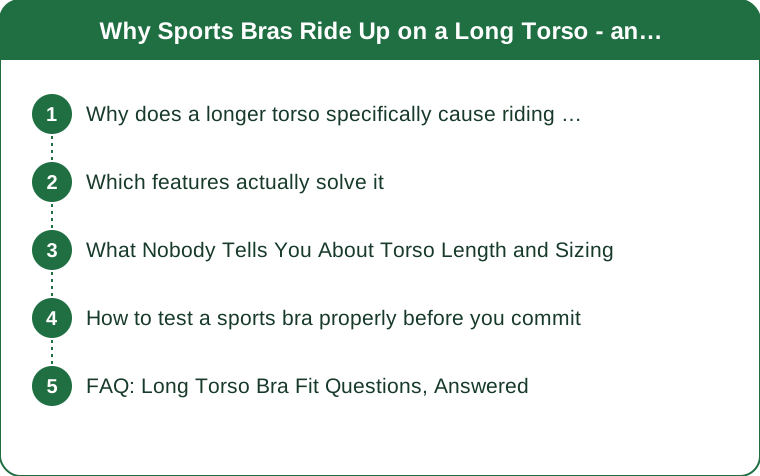
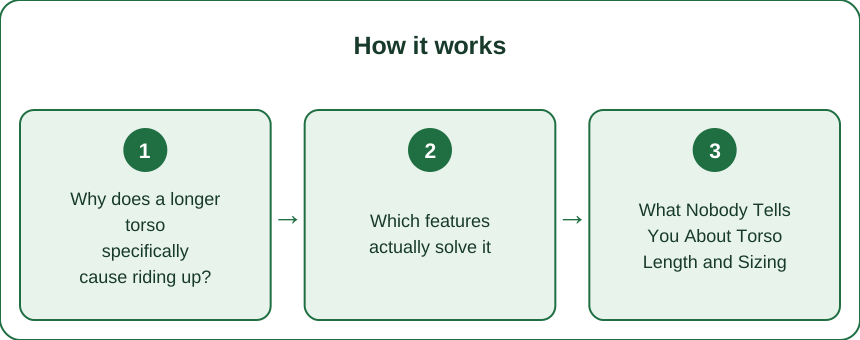
Why does a longer torso specifically cause riding up?
Because sports bra sizing runs on two measurements - underbust and bust - and neither of them describes the vertical distance the garment has to span.
Straps are cut for an average shoulder-to-underbust distance. On a long torso that distance can be several centimetres greater, and the strap has no more length to give. Every time you move, the strap pulls the band up toward the shoulder rather than the shoulder pulling down toward the band.
The band then sits above your ribcage’s widest point. A band anchors by sitting on the part of the ribcage that resists it moving upward. Once it has ridden above that point, there is nothing holding it and it keeps travelling. This is why it happens gradually and then suddenly.
Sizing down makes it worse. A tighter band grips harder but is being pulled by the same too-short straps, so it still climbs - and now it is uncomfortable while climbing. The strap-to-band relationship is the problem, not the band circumference.
Compression styles compound it. A pure compression bra distributes pull through the whole garment, so a short strap drags the entire thing. Encapsulation styles, where each cup is separate, spread the load differently and often behave better.
And impact multiplies all of it. Every landing produces a downward force that the straps resist, and each resistance is a tiny upward tug on the band. Over an hour of running that is thousands of small tugs, which is exactly what you feel.
Which features actually solve it
Four things, roughly in order of how much difference they make.
1. Adjustable straps - non-negotiable. This is the single most important feature for a long torso and a surprising number of sports bras omit it. You need the ability to lengthen the strap so the band can sit where it belongs. If a bra has fixed straps, no amount of anything else will fix it.
2. A wide underband. A band of 4 to 5 centimetres or more distributes tension across a larger area of ribcage and grips considerably better than a narrow elastic. Narrow bands roll and then climb.
3. Longline cuts. A longline bra extends the band down toward the natural waist, which anchors against a larger surface and a section of the torso that does not narrow. For long torsos this is often the complete answer, and it has the useful side effect of never leaving a gap with high-rise leggings.
4. Racerback or crossback construction. A racerback pulls from the centre of the back rather than from two points at the shoulders, which changes the direction of the force and reduces the upward drag. Convertible styles that let you switch between straight and racerback are worth seeking out.
What does not help, despite being recommended constantly:
- Sizing down the band. Makes it tighter and it still rides
- Tightening the straps. This is the exact opposite of what you need - shorter straps pull harder
- Higher impact ratings on their own. A high-impact bra with fixed straps still rides on a long torso

What Nobody Tells You About Torso Length and Sizing
Almost no brand publishes a torso length measurement. Size charts give underbust, bust, waist, and hip - all horizontal. The vertical dimension that causes most of the fit problems on a long torso is simply absent from the chart, which is why the chart keeps telling you the size is right when it is clearly wrong.
Bra size and torso length are unrelated. You can be a 32 band with a very long torso, and the garment designed for a 32 band assumes a torso length that has nothing to do with you. There is no size that fixes a proportion problem.
The tell that it is torso length and not size: the band feels correct when you first put it on, and rides up during movement. A band that is genuinely too loose feels loose immediately. A band that starts right and travels is being pulled.
Loosening the straps often feels wrong and is usually right. People instinctively tighten straps when a bra moves. On a long torso, lengthening them lets the band settle down onto the ribcage where it can anchor - and it feels less supportive for about thirty seconds before it feels better.
Bodysuits and built-in-bra tops solve this outright for lower-impact activity, because the garment is anchored at the hips and has nowhere to travel. For yoga, pilates, and lifting, this is often the easiest answer.
And the brands that fit you are usually consistent about it - fit is a house pattern, so once you find one that accounts for a longer torso, most of its range will work.
How to test a sports bra properly before you commit
Five minutes in a changing room saves a year of adjusting.
The tests, in order:
- Two fingers under the band at the front and back. Snug, not tight. If it is already tight standing still, it will be uncomfortable and it will still ride
- Raise both arms overhead and hold. This is the decisive test. If the band lifts more than 2 to 3 centimetres, the straps are too short for your torso. Most bras fail here and most people never try it
- Lengthen the straps and repeat. If the arms-overhead test improves substantially, adjustable straps are doing their job and this bra can work
- Jump ten times. Not two - ten. Riding up is cumulative and two jumps will not show it
- Check the band position afterward. It should still be sitting level and below the bust
What to buy given all of this:
- Longline with adjustable straps for running and high impact. This combination solves the problem for most long torsos
- A racerback or convertible style as the second option
- Bodysuits or built-in-bra tops for lower impact
- Wide underband, always, whatever else you choose
And a note on when it is worth stopping. If a bra rides up, digs in, or leaves marks that last more than 20 minutes, it is not a garment to persevere with. Persistent shoulder or upper back discomfort from bra straps is worth taking seriously rather than adjusting around forever - a proper fitting from someone who accounts for torso length is a reasonable next step.
FAQ: Long Torso Bra Fit Questions, Answered
Should I go up a band size instead of down?
Usually not - a larger band is looser and will move for a different reason. The band size is generally correct; the vertical distance is the issue, so look for longline and adjustable straps before changing the number.
Do bra extenders help?
They make the band circumference larger, which is not what a long torso needs. They solve a different problem entirely, and using one here usually makes the band move more.
Why does it happen more with some activities than others?
Impact and arm movement. Running and anything overhead produce the repeated upward tug; cycling and lifting without overhead work produce far less, which is why the same bra can seem fine in one session and impossible in another.
Are longline bras hot in summer?
They can be in a thick compression fabric, and lighter mesh-panelled longline styles exist for exactly this reason. The extra coverage is worth the trade for most people who have been fighting a riding band.
TL;DR:
- Riding up is caused by straps that are too short pulling the band upward, not a loose band
- Sizing down tightens the band without fixing the pull, and makes it uncomfortable too
- Adjustable straps are essential; wide underbands, longline cuts, and racerbacks all help
- Test by raising both arms overhead - if the band lifts more than 2 to 3cm, it will ride
- Bodysuits and built-in-bra tops solve it outright for lower-impact training
Next time you try a sports bra, put both arms straight overhead and watch the band. That one movement tells you everything the size chart cannot.
See It in Motion
Keep Reading
This article is for general informational and styling purposes only. Fit, sizing, and product availability may vary.
