Why Tank Tops Are the Hardest Item to Buy With a Long Torso
Quick Answer: Tanks fail on a long torso because they have to solve four length problems simultaneously — armhole depth, strap length, front length and the position of any built-in shelf bra — and standard sizing scales all four together with chest width rather than torso length. Sizing up gives you a wider garment with only marginally more length, plus gaping armholes. The solutions are longline cuts, tall ranges, adjustable straps and buying a size for the shoulder rather than the hem.
Every tank is either two inches short, gaping at the armhole, or has a shelf bra sitting somewhere around your ribs.
Usually all three.
Here is why the same size that works for everyone else does not work for you.

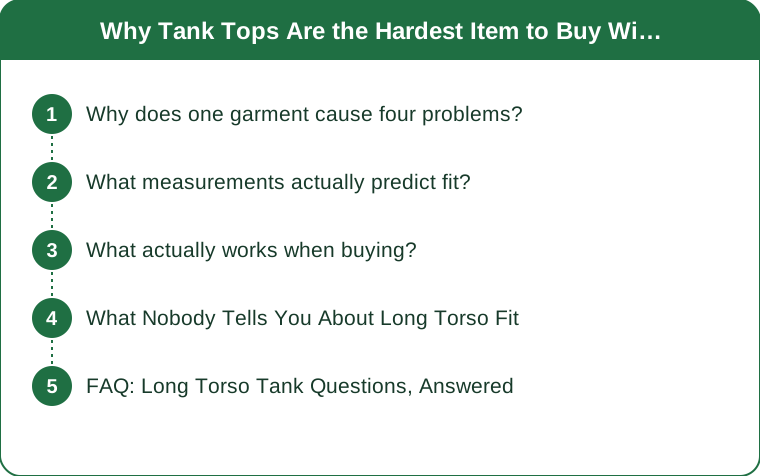
Why does one garment cause four problems?
Because a tank has no structural elements to absorb a length mismatch.
There are no sleeves to redistribute the fit. A t-shirt’s sleeve seam gives the pattern somewhere to compensate. A tank’s armhole runs directly from shoulder to side seam, so any length difference shows immediately as a deep, gaping armhole.
Straps are cut for average shoulder-to-bust distance. A longer torso usually means a longer distance from shoulder to underbust, so fixed straps pull the neckline up and the armhole down at the same time.
Front length is scaled by size, not by height. Going up a size typically adds a couple of centimetres of length and considerably more width. The ratio is wrong for the problem you have.
Built-in shelf bras are positioned by pattern, not by body. A shelf bra sits where the pattern puts it. On a long torso that is frequently above the underbust, which is uncomfortable and provides no support.
Ribbing and stretch make it worse in a specific way. A stretchy tank will physically reach, but it does so by pulling narrower, which means it clings where you did not want it to and still rides up.
Side seam curve lands in the wrong place. Many tanks have a waist-shaped side seam. On a long torso that nip lands above your actual waist, which reads as a fit error even when the length is fine.
What measurements actually predict fit?
Two, and neither of them is your dress size.
Hollow to hem is the number that matters. Measure from the hollow at the base of your throat straight down to where you want the hem to sit. Compare that to a brand’s stated garment length plus their shoulder-to-neckline offset. Many brands publish front length; almost nobody uses it.
Shoulder to underbust is the second. This predicts whether a shelf bra or an empire seam will land correctly. Measure it once and write it down.
Armhole depth is worth knowing too. Measure a tank that fits well from shoulder seam to the bottom of the armhole. Take that number shopping.
Your torso-to-leg ratio does not matter here. Long torso and short torso are about the trunk measurement itself, and inseam length tells you nothing useful about tank fit.
Ignore height on size charts. Two people of the same height can differ by 8 centimetres in torso length. Height-based tall ranges help, but only because they are longer, not because they are targeted.
Check the flat measurement, not the model photo. A tank photographed on a 178 centimetre model with a short torso will look long and will not be.

What actually works when buying?
A specific set of features, and one buying strategy that solves most of it.
Buy for the shoulder and armhole, then solve length separately. The shoulder fit is the hardest thing to alter and the easiest to get wrong by sizing up. Length can be added; a gaping armhole cannot be fixed.
Look for longline or tunic-length cuts. These are drafted longer rather than sized longer, which means the armhole and strap stay proportionate.
Adjustable straps solve two problems at once. They fix strap length and, on styles with a built-in bra, they position the shelf correctly.
Racerback and high-neck styles gape less. A higher neckline and a narrower back panel reduce the armhole depth problem substantially.
Choose separate bra styles over built-in shelves. Unless the straps adjust, a built-in shelf on a long torso is usually in the wrong place and cannot be moved.
Tall ranges are worth checking even if you are not tall. They are drafted with more torso length, which is what you need regardless of your actual height.
Ribbed and structured knits hold length better than thin jersey. Thin jersey rides up; a structured rib stays put.
Consider layering tanks specifically designed to be long. Several brands make extra-long fitted tanks for exactly this, and they solve the untucked problem permanently.
Seasonal note: as layering season arrives, the long tank becomes the most useful item in the wardrobe rather than the most frustrating one — it is the piece that stops a shorter jumper from exposing a gap. Buy the long ones now while summer stock is discounted.
What Nobody Tells You About Long Torso Fit
Sizing up is almost always the wrong move. It adds width where you did not need it and barely any length where you did. This is the single most common mistake.
The armhole is the tell. If you try on a tank and the armhole comes down to your bra band, the garment is too short for you — not too small.
Menswear tanks are often longer. Not for everyone stylistically, but the drafting frequently solves the length problem outright.
A tailor can add a hem band cheaply. Adding a contrast or matching band to the bottom of a tank costs very little and is a genuine solution for a piece you love.
Bodysuits solve the ride-up problem entirely. They are the reliable answer for anyone who spends their day pulling a hem down, provided you find one with enough torso length — check the shoulder-to-gusset measurement.
Brands are consistent with themselves. Once you find a brand whose torso length works, that is a much better signal than any individual garment review. Buy repeats.
High-rise bottoms are your ally. They close the gap from the other direction and reduce how much length the top actually needs to deliver.
FAQ: Long Torso Tank Questions, Answered
How do I know if I have a long torso?
If your waist sits lower relative to your elbow than average, tops routinely run short, and one-piece swimsuits pull uncomfortably, that is the pattern. A tailor can measure it precisely in a minute.
Should I just buy tall sizes?
Often yes for tops, even if your legs are average length. Tall ranges add torso length, which is what you actually need.
Why do one-piece swimsuits feel so bad?
Same problem in its most extreme form — the garment has to span the full torso with no give in length. Look for long-torso-specific swimwear, which several brands make.
Do bodysuits actually help?
Yes, provided the torso length is right. Check the shoulder-to-gusset measurement rather than the size label.
Can a tailor lengthen a tank?
Adding a hem band, yes, easily. Lengthening the armhole or strap, generally not without remaking the garment.
Is it better to layer instead?
Layering a long tank under a shorter top works well and is often more practical than searching for one perfect piece.
TL;DR:
- A tank has to solve armhole depth, strap length, front length and shelf position at once.
- Sizing up adds width, not length. It is the most common mistake.
- Measure hollow to hem and shoulder to underbust once, and shop with those numbers.
- Buy for the shoulder and armhole; length can be added by a tailor, gaping cannot be fixed.
- Tall ranges, longline cuts, adjustable straps, racerbacks and bodysuits all work.
Check the armhole before the hem. It tells you everything in five seconds.
See It in Motion
Seen here: Racerback Tank Top - White — shop similar styles on bubblelime.com
Keep Reading
This article is for general informational and styling purposes only. Fit, sizing, and product availability may vary.
